After last week’s drama involving Adobe’s change to their ToS that seemed to suggest that they were granting themselves the right to access content created by their users—and the resulting vague back-peddling and clarifications that made users go “yeah suuuuurrrrreeee…”—I, like many others, decided to start taking steps to limit Adobe’s impact on our creative workflow. In my case, it’s going to be a gradual phasing out because I paid for a year upfront back in February. The only thing I need to do is remember to cancel when that date comes up.
I ripped the band-aid off and took advantage of Affinity’s 50%-off sale. I completely removed Creative Cloud from my computer, especially since Adobe doesn’t seem to be forthcoming about what exactly they want to do with user’s content.
Table of Contents
Photoshop: The Beginning
I started using Photoshop back in 2000, three years before Adobe adopted the CS moniker. I was using it not for photo manipulation but for building web site elements. This was at the same time I was getting heavily into web design—running a Ronin Warriors fan-site turned out to be a good introduction to a lucrative career choice, though that would take me six years to decide to formally pursue.
One could say that Photoshop was a constant throughout my creative journey. Back then, Macromedia existed as a separate company—I had ditched MS FrontPage (anyone remember FrontPage?) for Macromedia Dreamweaver. Photoshop introduced a means of generating layouts from a PSD via the Slice tool—I think that was version 6?
Between Photoshop and Dreamweaver, that became my go-to for creating web page layouts. So it was all the better for me when Adobe acquired Macromedia in 2005. As time went on and my programming skills grew, I eventually ditched Dreamweaver in favor of dedicated IDEs like Netbeans (now I use PhpStorm) but still stuck with Photoshop for my web design prototyping needs—yes, even after releases of tools that were better suited to prototyping, like Sketch and Figma.
For what I needed, Photoshop just worked. However, design prototyping wasn’t the only thing I used Photoshop for.
I also used it for post-production and page layout for my web-comic Silent Shadow—design purists would claim Illustrator is the better tool but my attitude is that you use the tools that feel the most comfortable to you. I simply felt more comfortable in Photoshop than I did in Illustrator.
Aside from my work on Silent Shadow, I also used Photoshop for creating textures for 3d models.
And yes, I did eventually use Photoshop for its intended purpose of photo editing and manipulation.
Adobe Is A Drug
To be honest, I’d been looking for alternatives to the Adobe Creative Suite for years—especially once Adobe graduated towards a subscription model. Paying ~$600+ a year was starting to break the bank both as freelance web developer and as a W2 employee, but trying to move to something else when those shortcut keys were so ingrained was difficult. I had the same problem with Blender until the devs started adopting industry-standard shortcuts when I started using Blender regularly with 2.79.
So maybe those shortcuts weren’t as ingrained as I thought they were. I tried Affinity six years ago when I working at what was arguably one of the worst places in my entire career. I didn’t like it. It was just enough like Photoshop to throw me off, plus I may have developed some negative feelings towards Affinity that had more to do with that employer than with the program itself.
That being said, that particular time period five to six years ago was a period of upheaval for me—what was happening, I won’t go into, but by 2020—I’d decided to start eliminating expenses, and that included Adobe. However, it was almost impossible for me to move away—especially once I needed a video editor and the free options weren’t really up-to-snuff (note: I hadn’t heard of Da Vinci Resolve at this point). So eventually, I got sucked back in.
Getting Rid of Adobe for Good
I’m riding the unemployment train again for the second time in five years. This happened directly after I paid for a year upfront. So that right there is incentive enough to look for free or low-cost alternatives.
Sorry Adobe, but you’re just too expensive for what you are for a broke hobbyist like myself. Adobe attempting to commit seppuku similar to Unity last fall via their TOS changes was simply an added incentive to look for alternatives.
Adobe’s changes to their TOS regarding AI shouldn’t be a surprise, considering the scandal they created last summer regarding their AI generating art using the styles of well-known artists. I remembered saying then that if these artists were hosted on Behance (which Adobe owns), then there was a high chance that there was something in the Behance TOS that granted Adobe the right to use those artist’ works in whatever manner that they see fit.
For me, getting rid of Adobe products has more to do with cost than with the TOS—though the TOS changes are enough to be worried about.
The Path Forward
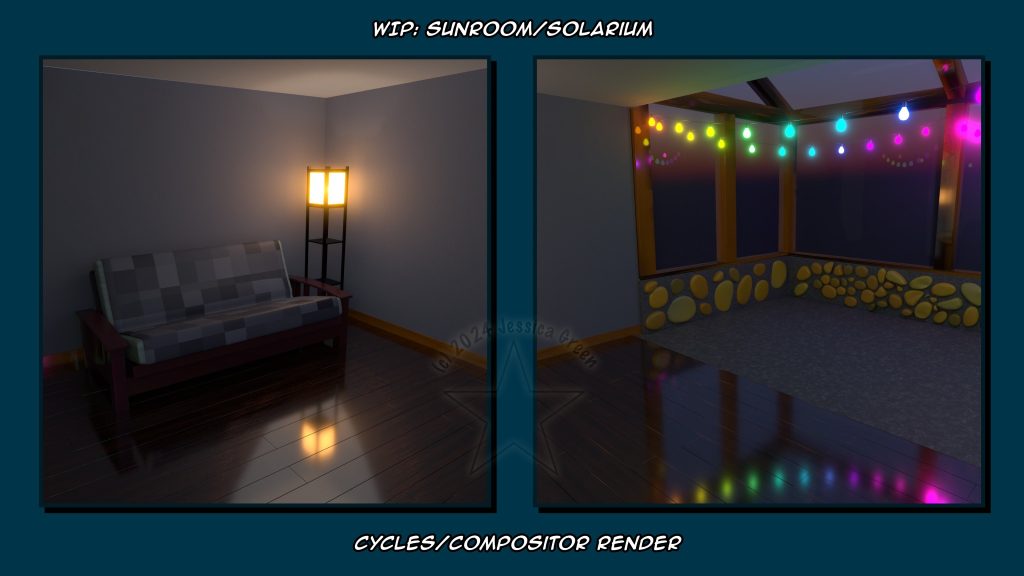
My most recent piece was put together using Affinity Photo 2 and aside from being faster than Photoshop on load, I found it easy to use once I shook off those PTSD triggers from six years ago. Photo 2 also offers the same tools as Photoshop if I need to do a quick mockup of a website. Essentially, I won’t be re-learning much, if anything at all.
I haven’t tried Affinity Designer—yet. I have a feeling that it’ll be just as snappy loading as Illustrator was 20 years ago, though. It won’t have any of the bloat that Illustrator has that no one uses.
Page layout for when I bring Silent Shadow back—at the moment, I’m playing with Comic Life 3, but I may test out Affinity Publisher as well.
For textures for 3d models, I’ve found that Blender’s texture painting tools suit my purposes just fine, with the added bonus of being able to create my own brushes from pngs as needed—which I can create those pngs in Affinity Photo. I experimented with Substance Painter years ago and didn’t like it, and I sure as hell wasn’t going to fork over more money to Adobe when there’s free alternatives readily available.
That being said, this is a huge paradigm shift for me—I’ve been using Adobe products most of my life, starting with Illustrator way back in Jr. High (’91/’92) and not gonna lie, I do feel sad but Photoshop as it was 20 years ago was way superior to the bloated, buggy mess that it is now.
And now, it’s time to say adios to Adobe!